


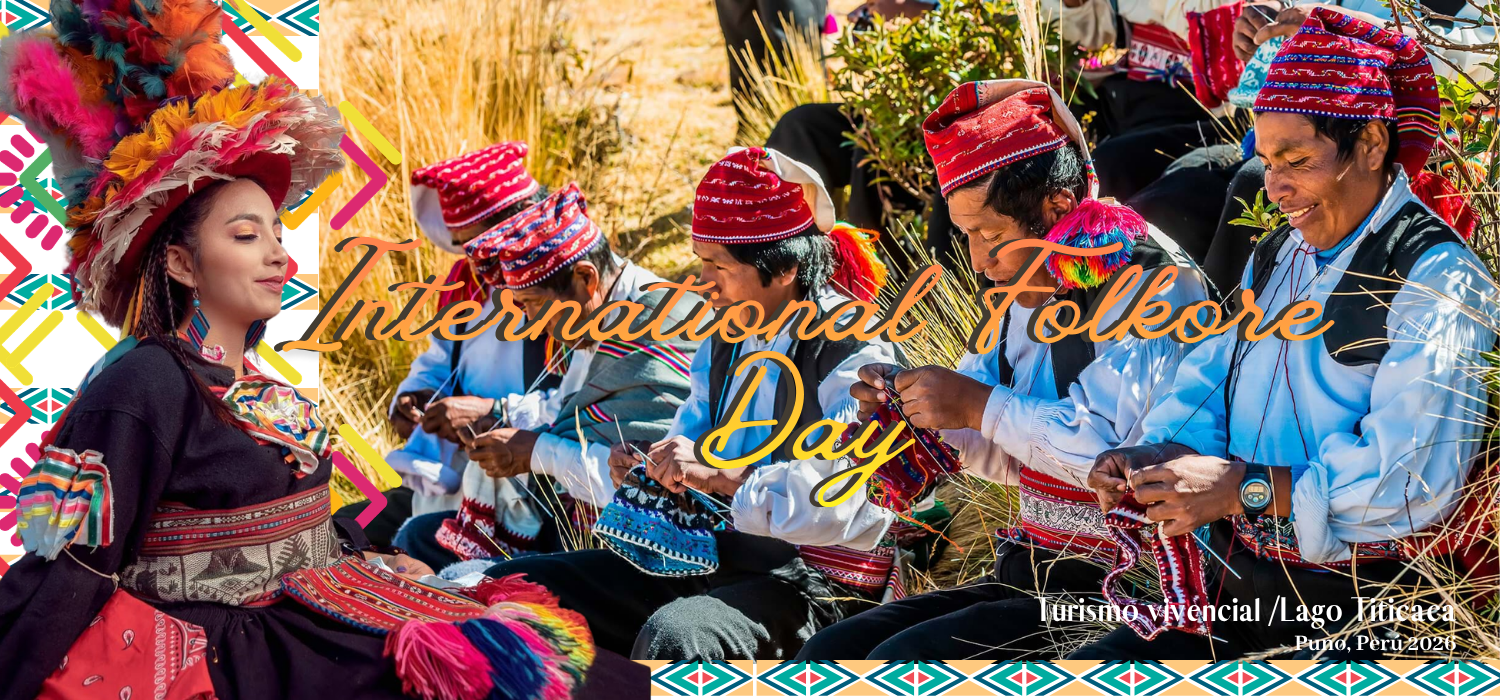
INTERNATIONAL FOLKLORE DAY/ The soul of a people is not written, it is danced
Every August 22, Peru pauses to celebrate what no postcard can fully capture: its folklore. And there is no better place to understand it than Puno.
If you ever wondered why Peru dedicates an entire day to folklore, the answer begins here, in the highlands. International Folklore Day is celebrated every August 22 in honor of William John Thoms, the researcher who in 1846 coined the term “folk-lore” to name something that, until then, had no name of its own: the set of traditions, music, dances, clothing, and knowledge that a people passes down from generation to generation, almost always orally.
In Peru, and especially in Puno, that definition doesn’t stay in books. It is seen, heard, and felt in every patron saint festival, in every panpipe, in every hand-embroidered costume that takes months to make.
01 — Why Puno holds the title
Puno is home to over 300 registered traditional dances and hosts the Festivity of the Virgin of Candelaria, recognized by UNESCO as Intangible Cultural Heritage of Humanity. It is no coincidence that it is known as the Folklore Capital of Peru: here, tradition is not preserved in a museum; it is lived every weekend in some street parade.
Dance
Diablada
Imposing masks and embroidered costumes represent the eternal struggle between good and evil. It is perhaps the most emblematic dance of the Puno highlands.
Music
Sikuris
Groups of panpipes playing in complementary pairs, a pre-Hispanic musical tradition that still sets the rhythm of Puno’s festivities.
Dance
Morenada
Slow-paced and colorful steps, with costumes that recall the colonial era and choreography that combines elegance and cultural resilience.
Folklore is not the past dressed up as a party: it is the way a people keep telling their story without needing words.
02 — Beyond dance: folklore that is woven and navigated
Puno’s folklore does not only live in parade costumes. It is also in the textiles of Taquile, declared Intangible Cultural Heritage of Humanity, made exclusively by men from childhood. It is in the floating islands of the Uros, made of totora reeds, where each family maintains customs dating back centuries before the Inca Empire. And it is in rituals like the Andean New Year, where the relationship with Pachamama remains as alive as ever.
Getting to know these traditions up close —not reading them on an information plaque— is the difference between visiting Puno and truly understanding it.
03 — Live the folklore, don’t just watch it
At Great Trip World, we believe these traditions are best enjoyed up close: sailing among the Uros islands, spending an afternoon in Taquile with its weavers, or touring the chullpas of Sillustani as the sun sets over the highlands. Each tour is designed so that folklore stops being a curious fact and becomes a real experience.
Discover Puno’s folklore firsthand
We design experiences in Uros, Taquile, and Sillustani so you can experience the living culture of the highlands, not just photograph it.
View available tours
Call +51 984 481 521
www.greattripworld.com · +51 984 481 521 · +51 951 753 244
20/08/2026